
Planning guide
Outdoor Fitness Equipment Types
Choose equipment once you know your users and your site. This page explains the main types, then shows where each sits in the UrbanFiT range.
The main types
What types of outdoor fitness equipment are there?
POSH names four groups: static, dynamic, seniors or rehabilitation, and ninja or obstacle courses.

Static
No moving parts. Users work against their own body weight.

Dynamic
Moving parts, such as a pedal or a weighted arm.

Seniors or rehabilitation
Equipment aimed at older or recovering users.

Ninja or obstacle
Courses built around obstacles.
POSH also notes that equipment can look like a gym, be bright and colourful, or be neutral in wood and grey. It can sit in a cluster, along a path or in a space shared with other activities.
Three questions sort most equipment:
- How does it work?
- What does it train?
- How is it laid out on site?
How it works
What is the difference between static and dynamic equipment?
Static equipment has no moving parts. Dynamic equipment does.
Static
Bars, benches, posts or platforms. Users work against their own body weight.
Dynamic
A pedalling or stepping mechanism, or a weighted arm that moves through a set path.
Neither is better. POSH's examples place static equipment along paths and in calisthenics-style clusters.
What it trains
What do different equipment types train?
Five training focuses cover most stations.

Strength
Muscles against load or body weight. Presses, pull-downs, leg presses, pull-up and dip bars, benches.

Cardio
Heart rate raised over time. Cycle and cross-trainer stations, step and jump platforms.
Balance
Control and stability. Beams, balance platforms, dexterity stations.

Mobility and flexibility
Range of movement and stretching. Stretch and rotation stations.

Calisthenics
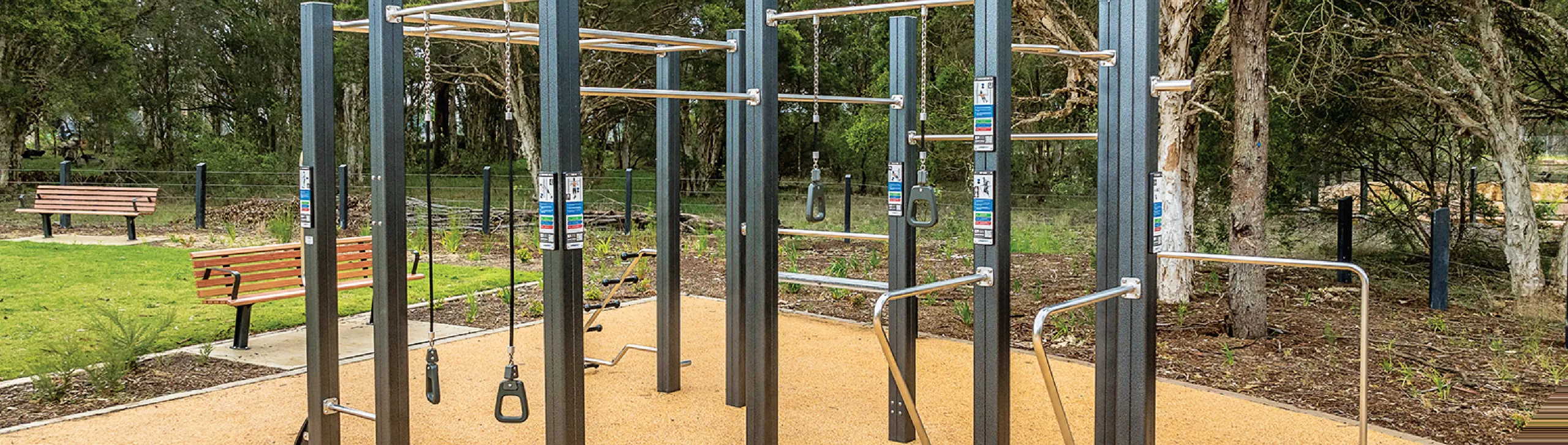
Push, pull, squat and core work with body weight. Parallel bars, parallettes, horizontal and overhead bars, squat poles.
UrbanFiT categories
How do these types map to UrbanFiT equipment?
Each exercise type has its own category page. Examples below come from the current listings.

Many stations carry more than one tag. The Jump Box, for example, is tagged for cardio and strength. Each product page lists the space required and the unit dimensions.
UrbanFiT ranges
What are the UrbanFiT ranges?
Three ranges: Activo, Trekko and Nitro. Mix stations across ranges to suit the site.
Layout
What is the difference between an outdoor gym, a calisthenics area and a fitness trail?
Where the stations sit: grouped in one spot, clustered for body-weight training, or spread along a path.

Format 1
Outdoor gym
| Layout | A group of stations in one spot |
|---|---|
| Kit | Often gym-style equipment |

Format 2
Calisthenics area
| Layout | Static cluster, often near sports fields and clubrooms |
|---|---|
| Kit | Pull-up bars, dip bars, box jumps |
| Users | Athletes, enthusiasts, experienced gym users, personal trainers. Children may use it as play. |

Format 3
Fitness trail
| Layout | Stations along a walking or cycling path |
|---|---|
| Kit | Balance beams, signposted stations |
| Use | A planned workout on a walk or run, or a quick stop by passers-by |
A balanced mix
How do I build a balanced equipment mix?
Start from the users, then the site, then the equipment.
- Name the target groups. See who uses outdoor fitness.
- Choose a format that suits the location. See site selection.
- Cover several training types, so beginners and experienced users both find something.
- Add clear instructions. POSH notes that QR codes and signage help.
- Check the standard and the surfacing. See standards.
Exercise videos on the site show how each station is used. To rough out a mix for a given area, try the space planner.
Standards and upkeep
What should I check about standards and upkeep?
Ask for the documents behind each station, and what it needs to stay in service.

UrbanFiT equipment is designed to AS 16630:2021, the Australian Standard for permanently installed outdoor fitness equipment. It is also designed to suit the AS 4685 series (playground equipment and surfacing), so it can sit next to any community space, including playgrounds. Read the standards guide.
- Which documents show how this station relates to the standard?
- What does it need to be inspected, repaired and renewed?
Know your users and your site?
Browse the categories for stations that match your training focus. Then send us your site and user details for layout advice.
FAQs
Frequently asked questions
What is the difference between static and dynamic outdoor fitness equipment?
Static equipment has no moving parts and relies on body weight, such as bars and benches. Dynamic equipment has moving parts, such as a pedalling or stepping mechanism. Many sites mix both.
What is the difference between an outdoor gym and a calisthenics park?
An outdoor gym usually groups gym-style stations in one place. A calisthenics park groups bars and platforms for body-weight training. The Public Open Space Handbook treats both as outdoor fitness equipment.
Which outdoor fitness equipment suits beginners?
Beginners usually do best with a mix of simple stations and clear instructions. The right choice depends on the users and the site. UrbanFiT can suggest a mix for your project.
Source: Public Open Space Handbook, Edition 1 (2026), Parks and Leisure Australia and VicHealth. Summarised by UrbanFiT. General information only.