
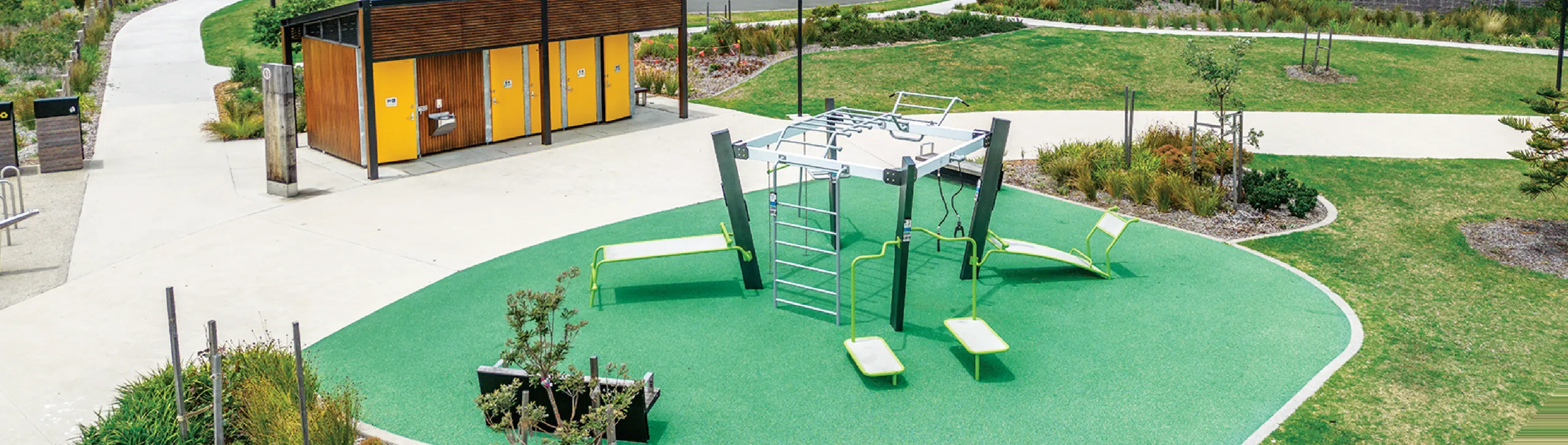

Planning guide
Outdoor Fitness Planning
A good outdoor gym starts with a decision about people and place, not a product list. Here are the eight stages every public project goes through, with a guide for each.
Definition
What is outdoor fitness planning?
Deciding whether, where and how to provide outdoor fitness equipment, and how to look after it once it's installed.
The Public Open Space Handbook describes outdoor fitness equipment by four traits. Councils usually own it.

Fixed in place
Permanently installed in public open space.

Free, unsupervised
Anyone can use it, with no staff on site.

Aged 14 and over
Designed mainly for teens and adults.

No utilities
Doesn't need power or water.
Playground equipment, temporary apparatus and kit used only for commercial or supervised training sit outside that description.
Why plan
Why plan before choosing equipment?
Because sites that skip the early questions repeat the same three problems.
Wrong users
Equipment chosen before anyone asked who lives nearby.
Poor location
No shade, no passing foot traffic, nowhere to sit.
No upkeep budget
A maintenance cost nobody planned for.
Communities and developers propose outdoor gyms more often than ever, but planning guidance is thin and not every install has worked. Plan first and you choose equipment that fits a stated purpose and a real site.
The project journey
What are the eight stages of an outdoor fitness project?
Strategy, need, funding, design and location, procurement, activation, maintenance and evaluation.
The Handbook takes this lifecycle from the Victorian outdoor fitness guidelines (2018). The logic works anywhere, but check your own state and council rules.
Before you buy

Strategy
Give the gym a purpose and a home in your open space or active living strategy.


Buy, open, look after


Activation
Signage and programs give people reasons to use it.
Guide coming

Maintenance
Inspect, repair and renew on a schedule you can afford.
Guide coming

Evaluation
Check the right people use it, then adjust.
Guide coming
Audience
Who should use this guide?

Councils
Open space and recreation planners, parks and asset managers, procurement.

Landscape architects
Site, layout and specification information.

Schools
Business managers and facilities staff.

Developers
Teams delivering public realm in new communities.
Settings
Where does outdoor fitness work?

Parks

Sports fields

Trails

Community hubs
Schools

Foreshore
Each setting suits different equipment and different users. The site selection guide shows how to compare options.
Q2D2
How do quantity, quality, diversity and distribution apply?
They're four questions, known as Q2D2, that test whether provision fits your community.
Q
Quantity
How much provision exists, and how much is needed?
Q
Quality
Is it useful, safe, accessible, inclusive and durable?
D
Diversity
Does it suit different users, abilities and training styles?
D
Distribution
Can people reach it where they live, work and study?
The adaptation is ours. The Handbook applies Q2D2 to open space generally, and its provision guidance is written for Victoria.
Standards
What standards and safety rules apply?

UrbanFiT equipment is designed to AS 16630:2021, the Australian Standard for outdoor fitness equipment, and designed to suit the AS 4685 series, so it can sit next to any community space, including playgrounds. Read the standards guide.
Whole of life
What does whole-of-life mean for outdoor fitness?
Budgeting for inspection, repair and renewal before you approve the design, not after.
Year 0
Year 1
Year 5
Year 10+
Bring your asset manager in early. The Handbook warns that features get removed when upkeep becomes too heavy. Bar is illustrative, not to scale.
How we help
How does UrbanFiT help with planning?
Our designers can join at any stage, from first idea to installation.
See how a project works and what the Care Plan covers. Every station is tagged by exercise type, so you can build a mix that suits your users.
Exercise type

Strength

Cardio
Balance

Flexibility

Resistance
Browse equipment by exercise type or see UrbanFiT projects.
Test your project before you brief a designer
The Outdoor Fitness Planning Checklist walks you through all eight stages.
FAQs
Frequently asked questions
What is outdoor fitness equipment?
Outdoor fitness equipment is exercise equipment permanently installed in public open space. It is free to use without supervision, designed mainly for people aged 14 and over, and does not need power or water. Councils usually own it.
Do we need a strategy before buying outdoor fitness equipment?
A strategy is not a legal requirement, but it helps. The Victorian lifecycle that the Public Open Space Handbook describes starts with strategy and need, so the location, users and budget are agreed before products are chosen. Your council may set its own requirements.
Does the eight-stage lifecycle apply outside Victoria?
The stages come from Victorian guidelines, but the sequence of strategy, need, funding, design, procurement, activation, maintenance and evaluation is sensible anywhere. Check your state, council and funding body for local rules.
Source: Public Open Space Handbook, Edition 1 (2026), Parks and Leisure Australia and VicHealth. Summarised by UrbanFiT. General information only, not legal or engineering advice.